Commercial by Design
The Commercial Side of the Company
Most companies build their product with discipline and their commercial side by improvisation. The product has a roadmap, a hypothesis behind every feature, a version history, and a habit of testing before it ships. The commercial side has a target, a headcount plan, and a forecast. One half of the company runs on evidence and iteration; the other runs on pressure and assumption, and the same leaders preside over both. They would never scale a feature nobody validated. Then they scale a revenue organization on a motion nobody validated, and when it stalls they blame the sellers, the market, or the quarter. We demand evidence from product. Too often, we accept assumptions from commercial.
That asymmetry is a design problem, not a talent problem, and it has one root cause. The knowledge of how the company actually wins lives inside a person instead of a system: who really buys and why, what opens a budget, what makes a deal move, stall, or die. Early on that knowledge sits with the founder, who found it by selling on instinct. Later it can sit with a first salesperson, a head of sales, a head of product, a regional leader, or an operator brought in to fix the problem. The location changes; the condition does not. Critical commercial knowledge trapped in a person quietly caps a company, and it does not care whose head it lives in. A company can hire around most gaps. It cannot hire around this one, because new people do not arrive with the knowledge; they arrive needing it, and there is nothing to hand them but one person’s time and memory.
The condition hides behind success. A company closes real deals and reads that as proof the commercial side works. Early revenue proves that someone in the building can sell. It does not prove the company can. Those first deals usually came from the founder, or the two or three people who started it, on relationships and conviction no one else can reproduce yet. That is worth a great deal, and it is still not a system. It is a person carrying every deal so well the results look like a machine. The better that person is, the longer the company can mistake their effort for a system. Traction is not an engine. Whether the company can sell without that person is a different question, and it is the only one that predicts what happens next.
I know the condition from the inside. For twenty-five years I was brought in after a founder had gotten something to work but could not make it repeat. I took the download, pulled out what they knew but had never written down, and built the system other people could run.
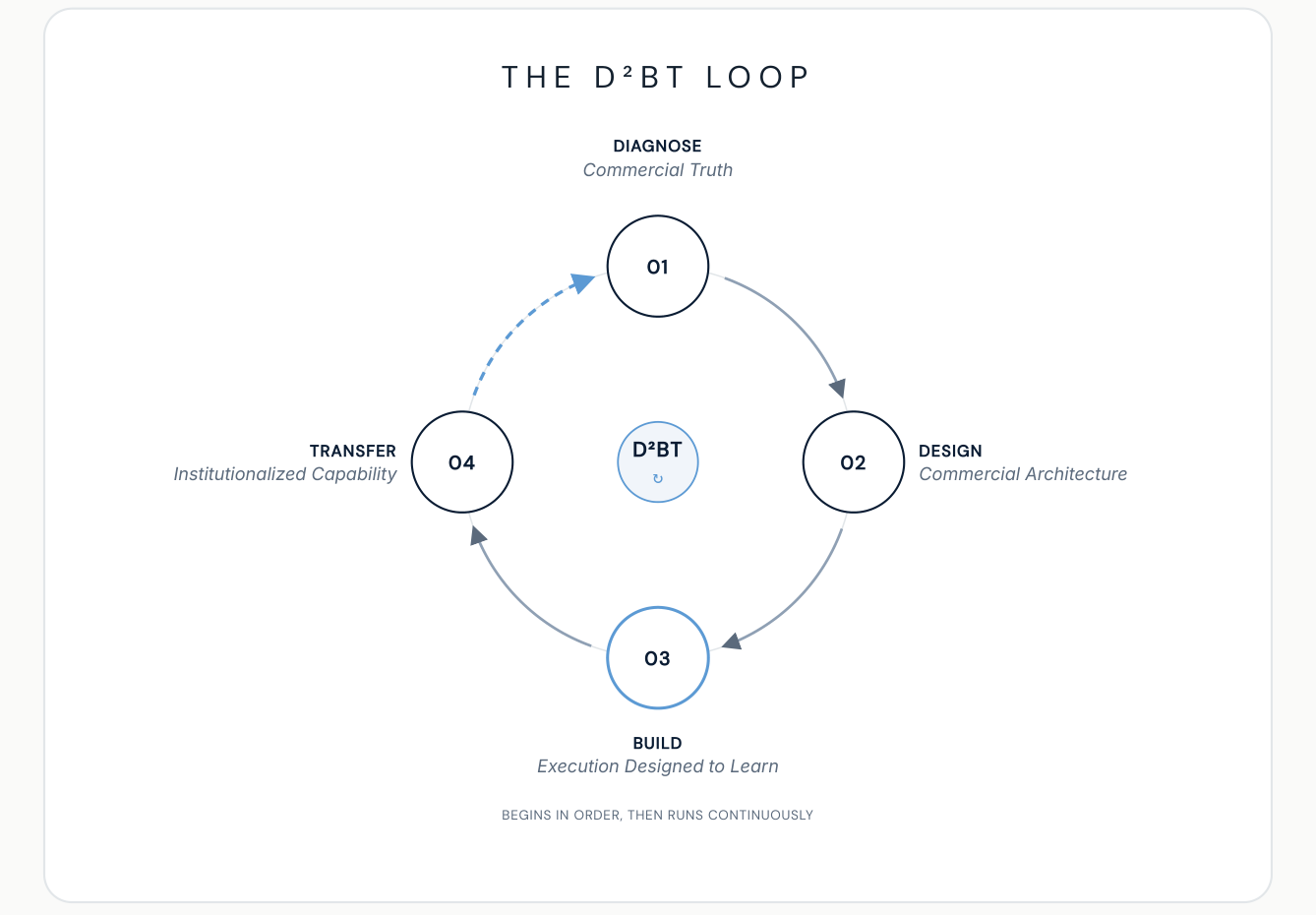
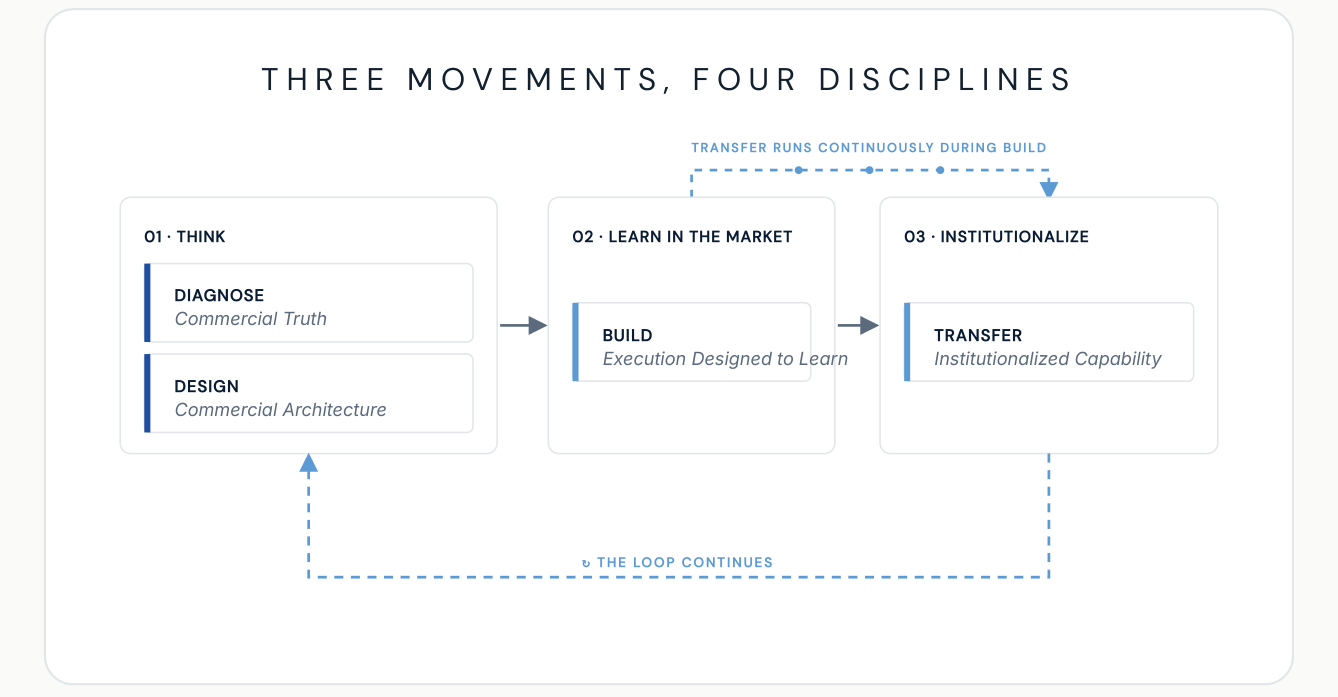
The answer is to build the commercial side with the discipline the product already gets: establish what is true, design from it, test in the market, and move the results out of any one person’s hands. D²BT did not begin as a named framework. It emerged from decades of solving the same class of commercial problem. The work came first; the language came later. It runs as three movements carried by four disciplines: first you think, in Diagnose and Design; then you learn in the market, in Build; then you institutionalize, in Transfer. The disciplines begin in that order, and the order is not arbitrary, because each rests on the one before it. Which is why the work starts where every honest commercial system has to start. Not with a plan. With what is actually true.
The chapters
- 01Diagnose: Commercial Truth
- 02Design: Commercial Architecture
- 03Build: Execution Designed to Learn
- 04Transfer: Institutionalized Capability
- 05The Commercial Engine
- 06Commercial Readiness
- 07Capital Readiness
Prefer the complete edition? Download the 57-page PDF
Commercial by Design © 2026 Gain Advisory LLC. All rights reserved.