Commercial by Design
Commercial Readiness
Every company eventually decides to pour fuel on the fire. It hires the team, raises the round, opens the new segment, doubles the target. And it makes that decision on the assumption that there is an engine underneath to accelerate. Most of the time, no one has checked. The company has revenue, the revenue has been growing, and growth is read as proof that the machine exists. Then the market runs one of its tests, a key person leaves, a quarter turns, a buyer who always said yes says no, and the company finds out what it actually had. By then the finding is a postmortem. The fuel has already been spent.
Readiness is the discipline of finding out before. It is the difference between believing the engine is real and knowing it, on evidence, while there is still time to build what is missing. And it begins with a distinction most companies never draw. Readiness is not a feeling. People speak of it the way they speak of momentum, as a sense that things are clicking, but a mood is not a measurement, and no company ever spent a mood on a hire or a raise. Readiness is a set of specific conditions that either exist or do not, and they can be looked at plainly, one at a time, before a dollar is committed to growth.
There are five. The first is Commercial Truth: whether the company can name the buyer it actually serves and point to the pressure that actually opens the budget, rather than describe a market in the abstract. This is what Diagnose leaves behind, and everything above it rests on it. The second is Positioning: whether the company’s promise repels the wrong buyer as clearly as it attracts the right one, or whether it could belong to ten other companies without changing a word. This is the first test of Commercial Architecture. The third is Repeatability: whether the motion closes deals that do not all run through the same few people, or whether the pipeline is a handful of individuals wearing the costume of a system. This is what Build proves, and it is the condition a departure tests most directly. The fourth is Fit: whether the motion matches how the real buyer actually decides, rather than how the company wishes they decided. And because a single company often sells to more than one kind of buyer, an enterprise that decides by committee and a smaller company that decides in a room are not one market, fit is rarely a single setting. It is whether the company has designed the right motion for each buyer it serves, rather than forcing one motion onto buyers who do not share a decision. A motion can be repeatable and still be tuned to the wrong decision, which is why fit is its own condition and not a restatement of the third. The fifth is Adaptability: whether the company changes its playbook because the market moved, or only after a crisis forces it to. This is Transfer and the pencil, the capacity to keep learning, and it sits underneath the other four rather than beside them.
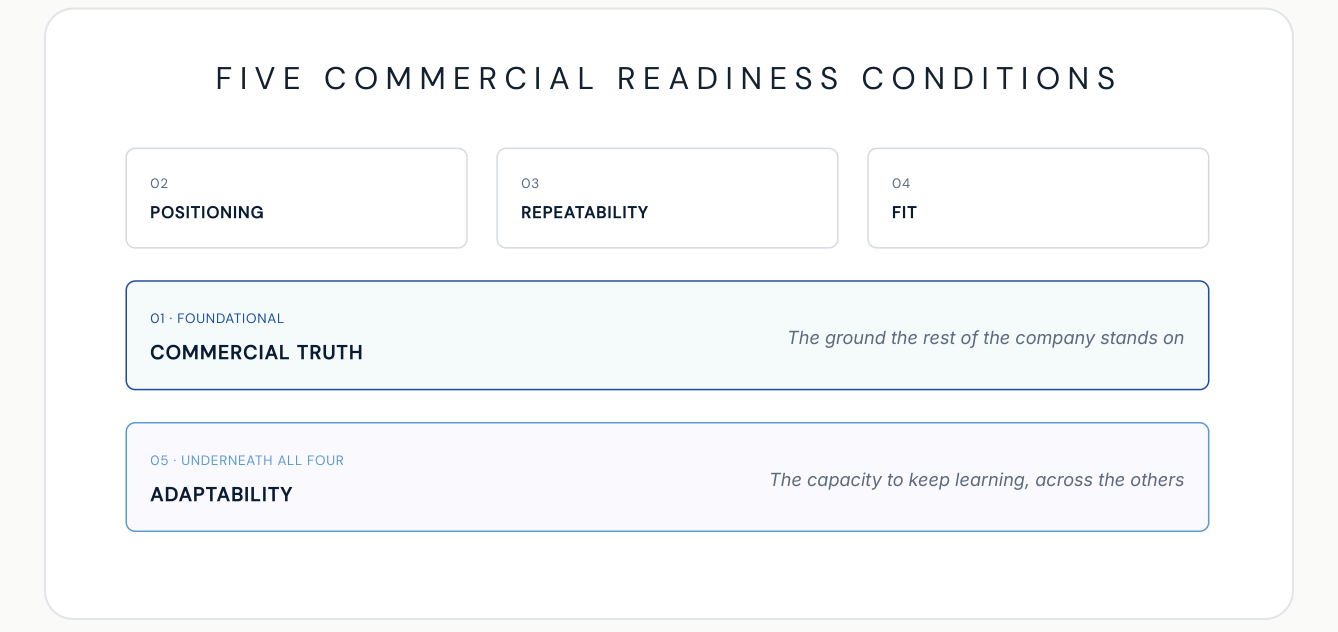
Read together, those five are the closest thing there is to a definition. A company is commercially ready when it holds a true account of its buyer, a positioning only it can own, a motion that repeats without a particular few people, a motion matched to how each of its buyers actually decides, and the capacity to change all of it on evidence. Readiness is not confidence that the engine will work. It is evidence that it already does, in conditions a company can name, look at, and score.
This is also where the method asks to be believed, on the only terms that should persuade anyone. It does not ask a company to take its word. It names five conditions and invites the company to check. A framework that explains everything and can be tested by nothing is a belief. One that names the specific things that must be true, and can be wrong about a given company, is a method. Commercial readiness is where Commercial by Design becomes checkable, against any company, including the reader’s own.
The order among the five is not negotiable, and it is the most useful thing the list has to teach. Commercial Truth comes before positioning, positioning before motion, a working motion before the hire meant to inherit it. Weakness at the top quietly poisons everything beneath it. A brilliant motion built on a misidentified buyer is only a faster way to the wrong place, and a company that reads itself from the bottom up will keep repairing symptoms while the cause sits untouched at the top. The temptation, looking at a list like this, is to grade gently. The more useful move is the opposite. An uncomfortable answer is not a verdict on the company or the people in it. It is a map, and it tells a company exactly what to build first.
Readiness is where a company holds the description up against itself and sees what it actually has, condition by condition. What a ready engine is finally worth, and to whom, is the last thing left to understand.
Continue your read.
Capital ReadinessCommercial by Design © 2026 Gain Advisory LLC. All rights reserved.