Commercial by Design
Build: Execution Designed to Learn
We had one product, and it was better than what the incumbent offered. Not a little better. Much better. We were getting into real sales processes, in front of people who wanted it. And then, over and over, right near the end, they pulled back. Come back to us later. Not now.
Before the story, the shape of it, because it is more common than it looks. A great many companies are in exactly this position: a genuinely better product, sold against a competitor that is not really a standalone competitor at all, but one piece of a much larger enterprise that sells a bundled solution. You are selling one excellent thing. They are selling forty things wrapped together, and the one you compete with is buried inside the wrapper. If that is not you, it may be because you created the category and have no serious incumbent yet, or because your competitor is still small and independent. Enjoy it, and do not assume it lasts forever. Categories consolidate. The day a large platform acquires your competitor and folds it into a suite is the day you start swimming upstream against a bundle, and everything in this chapter becomes your problem. So read it as a lesson in how markets actually behave, not as a story about one deal.
For too long I read the stall the way most sellers read it, as a timing objection. Bad quarter, budget already spent, catch me next year. A timing objection has an obvious response, follow up and wait, so that is what I did. It is the most natural move in the world, and it teaches you nothing, because it settles in advance what the stall meant and asks the market for nothing further. When enough of them said the same thing, the pattern got too loud to keep filing under timing, so I stopped waiting and took it apart. It was not timing. It was unresolved risk wearing a calendar for a costume. There were two things underneath, and neither one had anything to do with the season.
The first was in the pricing, and it was invisible from inside the building. Our product replaced one piece of what the incumbent sold, but the incumbent did not sell that piece on its own. They sold a bundle. So the customer did the math in their head, and the math was wrong in a way that worked against us. Say our product costs fifteen thousand. The buyer assumes they will cancel the piece they currently get from the incumbent, free up that fifteen thousand, and simply point it at us. Even trade. Except that is not how a bundle prices. Inside the bundle, that single piece was never really worth fifteen thousand on its own; it was cheap to keep because it was carried by everything around it. Cancel it and the buyer does not recover fifteen thousand. They recover a fraction of it, because the rest of the bundle holds its price. So the buyer who thought they had a full budget to redirect suddenly finds they have to come up with most of our price as new money. The incumbent bill barely moves. The point is that the budget the buyer was counting on to pay us was never really there, and it was killing our deals quietly, in a spreadsheet we never saw. That was not a selling problem. It was a pricing problem, and we fixed the price to the real math, and deals that no amount of better positioning would have moved started moving.
The second thing was quieter and it was the real one. For example, their contract with the incumbent ended December 31. Our product had to be live January 1. One day, no overlap, no fallback if something broke during the most visible moment of their year. We were asking them to leap a gap with no bridge and bet their quarter on a vendor they had known for a few months. Of course they froze. Come back next year was not procrastination. It was a person declining to jump a cliff we had not built a bridge over.
So we built the bridge. Sign earlier and the billing did not start until the incumbent contract actually ended, which gave the buyer roughly three months of overlap to move at their own pace. No double paying, no stranded month with two live vendors, no hard cutover on a single terrifying day. And come back next year stopped being the answer, because the thing underneath it was gone. We had not made the product any better. We had made the decision less dangerous. We had not overcome an objection. We had redesigned the way the customer bought, and building that bridge was a commercial and a financial decision at once, which is exactly why finance belongs inside the architecture and not downstream of it.
The specific fix is not the lesson; run it on a buyer who is not afraid of the switch and you will have given away three months for nothing. The lesson is where the fix came from. None of it came from the plan, which said the product was better and the market would reward the better product. It was coherent, and wrong in two exact ways no one inside the company could have reasoned out, because the information was not inside the company. It lived only in the market, in the gap between the math we imagined and the math the buyer actually did, in the fear hiding inside a polite delay. The architecture proposed. The market disposed. This is the trap that swallows years. A company can execute relentlessly, quarter after quarter, and preserve the very mistake it is working so hard to outrun, because effort spent on a wrong assumption produces nothing but a great deal of well-run wrongness. Motion is not progress. Companies do not become better because they execute longer. They become better because they change what they execute, and they learn what to change only when the market has told them.
That is what separates two companies that look identical from across the room, both busy, both executing. For one, execution is the implementation of a plan: it runs the motion to hit the number, and when the market resists it reaches for the explanation that asks nothing of it, timing or budget or a soft quarter. And it executes harder. That company cannot learn, because a plan being implemented has no channel to hear anything it did not already believe. For the other, execution is a disciplined process for discovering reality: every deal is a question put to the market, every stall is data, every loss a finding, and that company pulls ahead not by executing more but by learning faster than the one still arguing with its own pipeline. Underneath both is the same relationship between a plan and the work. A plan is what a company believes. Execution is how the market tells it what is true.
Here is the honest objection, and it deserves an answer, because most companies believe they already do this. They do course-correct. When a real headwind hits, or a competitor makes a move, or the macro turns, they react. They update the collateral, change the pricing, tell the field to stop saying the old thing and start saying the new one. That is real, and it is not nothing. But look at when it happens. It happens on big events, at major milestones, when something forces it. It is course correction as an emergency response, not as a habit, and a muscle used only as defense versus offense is never strong when it matters. The company that learns fastest does this continuously and on purpose, in small increments, when nothing is on fire, so that reading the market and adjusting is not a fire drill but the way the place runs. The point of Build is to build that muscle, to make the loop between the market and the motion so ordinary that the company is adjusting before the headwind is big enough to have a name.
And building that muscle asks something specific of the people at the edge, the ones in front of customers. Most companies, when they change the motion, hand the field the new decision and stop there. Say this now. Price it this way. Lead with that. What they do not hand over is the reasoning, and so the field can recite the change but cannot carry it, cannot answer the question underneath it, cannot flex it when the buyer pushes in a direction the script did not anticipate. A client-facing team that only has the decision performs like a team reading a card. A client-facing team that understands why the decision was made speaks like the executive who made it, and can hold a real conversation at the buyer’s level. This is the same principle as the architecture, arriving in a different room: it is never enough to hand over the play. You have to hand over the thinking that produced it.
Living inside that relationship asks something of a company that effort cannot supply. A company can do everything right and still be told no: the architecture coherent, the team good, the execution disciplined, the leadership certain, and the answer still no, with every internal virtue intact. Most commercial failure is not weak execution. Plenty of failing companies execute beautifully. It is the substitution of internal certainty for external truth, the assumption that a plan sound inside the building must be sound outside it. The market is the only authority that can settle that, and it is not grading effort. It is revealing reality. So its no is not resistance to be overpowered. It is information. The market is never wrong. It is only telling you something you have not understood yet.
Which is why execution, which produces nothing on its own, is worth what it is worth: it is the only thing that gives the market the chance to answer, and that answer is the only evidence that counts. Execution creates no value. What it exposes does. Run the motion for a quarter and change nothing, and it was activity, however busy it looked and however healthy the dashboards read. Change the architecture because the market revealed something the company had not understood, and it created knowledge. That is the purpose of Build, and the whole distance between a company that is moving and one that is improving.
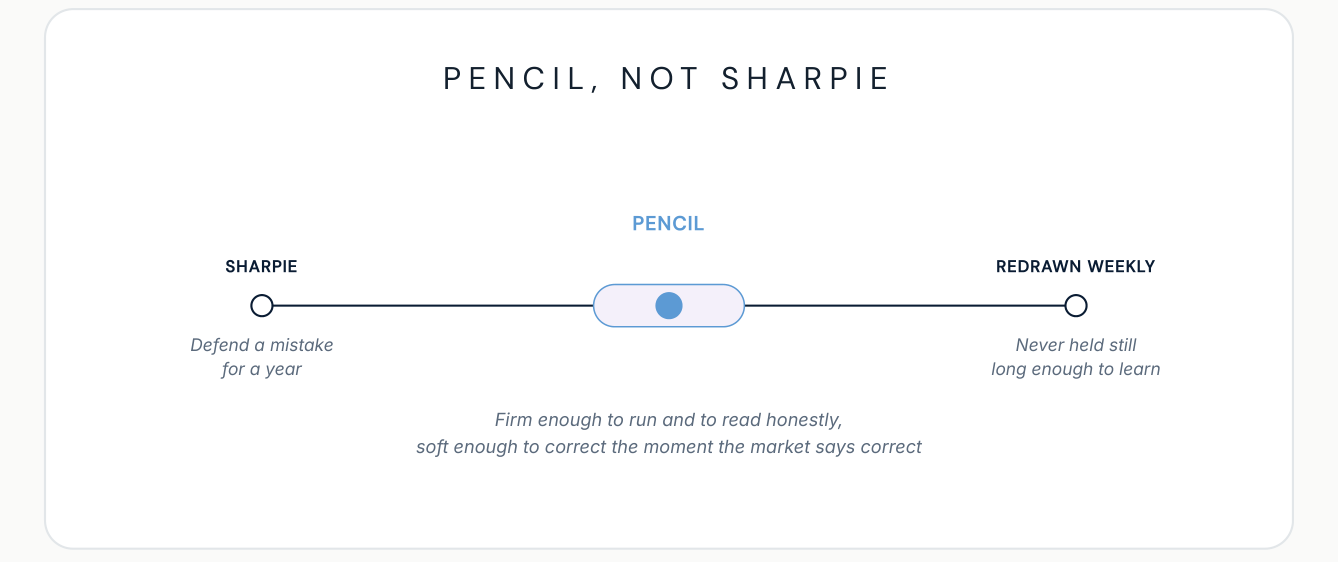
This is also why the architecture has to be held a particular way. If the pricing and the switch had been treated as settled, written in Sharpie because a smart team had reasoned them out, the stall would have stayed a mystery or hardened into an excuse. The correction was only possible because nothing in the motion was above being overruled by evidence. Companies get this wrong in both directions. Write the motion in Sharpie and you will defend a mistake for a year while the market keeps trying to tell you. Redraw it every week on every stray reaction and you learn nothing either, because you never hold a version still long enough to find out whether it worked. So the motion is kept in pencil, not Sharpie. Firm enough to run and to read honestly, soft enough to correct the moment the market says correct. That is not indecision. It is the only handwriting that lets a company be both committed and still learning.
The market does not only correct the motion. It teaches you that there is rarely one motion. The same product sold into a large enterprise and into a smaller company is not the same sale, because the buyers do not decide the same way. The enterprise buyer moves through committees and procurement and risk review; the smaller buyer decides in a room, faster, on different fears. The way you sell, the proof you bring, the risk you retire, the pace you set, all of it has to fit how that particular buyer actually decides, and a motion tuned for one will misfire on the other. So a single company often needs more than one fit, sometimes several, designed deliberately by segment and validated separately, each one a hypothesis the market confirms or corrects. This is what the architecture could only anticipate and Build has to finish. Fit is not a setting you choose once. It is a match you keep making, buyer by buyer, segment by segment, and getting it right for each is part of what turns a motion into an engine.
The same logic is why a company proves the motion before it scales the motion. Had we taken the original version, better product, wrong pricing, no bridge, and poured headcount and volume onto it, we would not have grown. We would have scaled the stall and hired a team to be confused by it at ten times the cost. Execution built to learn runs a minimum viable motion first, deliberately small, precisely so it can find the bundle math and the missing bridge while they are still cheap to find. A company scales the motion the market has confirmed, never the one it hopes the market will confirm. Scaling ahead of that confirmation is not ambition. It is multiplying an untested assumption and calling the multiplication growth.
This is where the sequence stops being a line and becomes a loop, with each turn through the market making the truth more accurate and the motion more fit. But a loop that lives in the people who ran it is not yet an engine. It is a very sophisticated dependency, and making it belong to the organization instead of to those people is the last discipline, the one almost no company finishes.
Commercial by Design © 2026 Gain Advisory LLC. All rights reserved.