Commercial by Design
The Commercial Engine
The test of a commercial engine is a departure.
Someone leaves. The person who carried the largest accounts, or read the market better than anyone else in the building, or simply knew, without ever being able to fully explain how, which deals were real and which were noise. Or it is not one person but a few, the small group who between them held the whole picture. In one company, the market never notices they are gone. Deals keep closing. The forecast holds. The next people come up to speed on a system that was ready for them. In another company, the pipeline that looked so healthy the week before quietly comes apart, and everyone discovers, a quarter too late, that what they had been calling a system was those few people, and now they have left.
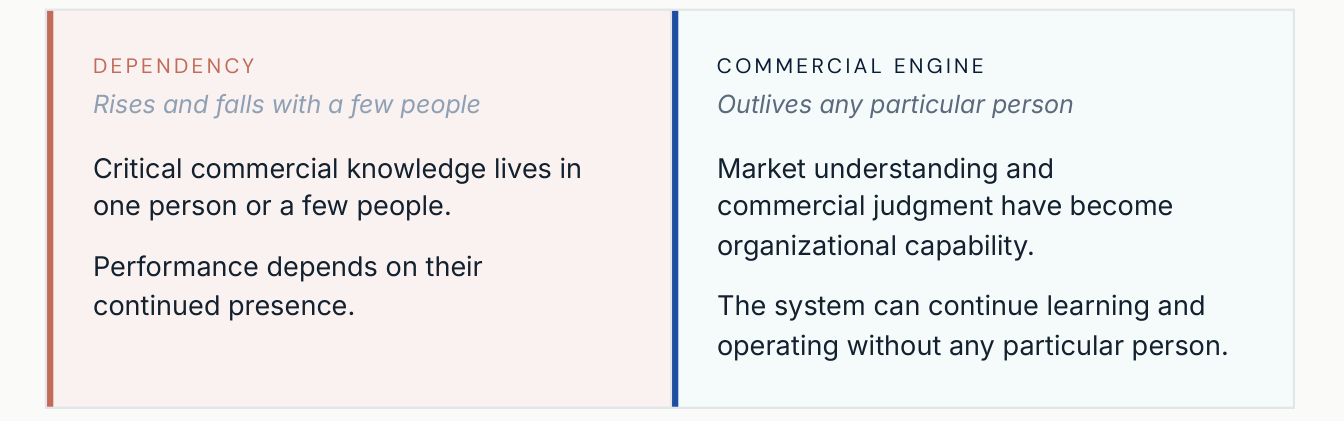
Both companies had revenue. Both had a team, a process, a stack of tools, a number they hit last year. From across the room they looked identical. The departure is the only thing that told them apart. But the departure is a test, not a definition. It reveals whether an engine is there; it is not the engine itself. What it was testing for is visible only in what the four disciplines build when they are working, because that is the thing a departure either survives or exposes.
That thing has a name. It is what the four disciplines have been building from the beginning. Commercial Truth, turned into Commercial Architecture, tested and corrected in the market by Build, and made into organizational capability by Transfer, is a Commercial Engine. It is the system that turns market understanding into repeatable revenue without depending on the intuition, heroics, or effort of any one person or any few. The word that carries the definition is depending. Not a company without people. A company that does not rise and fall with any particular ones of them.
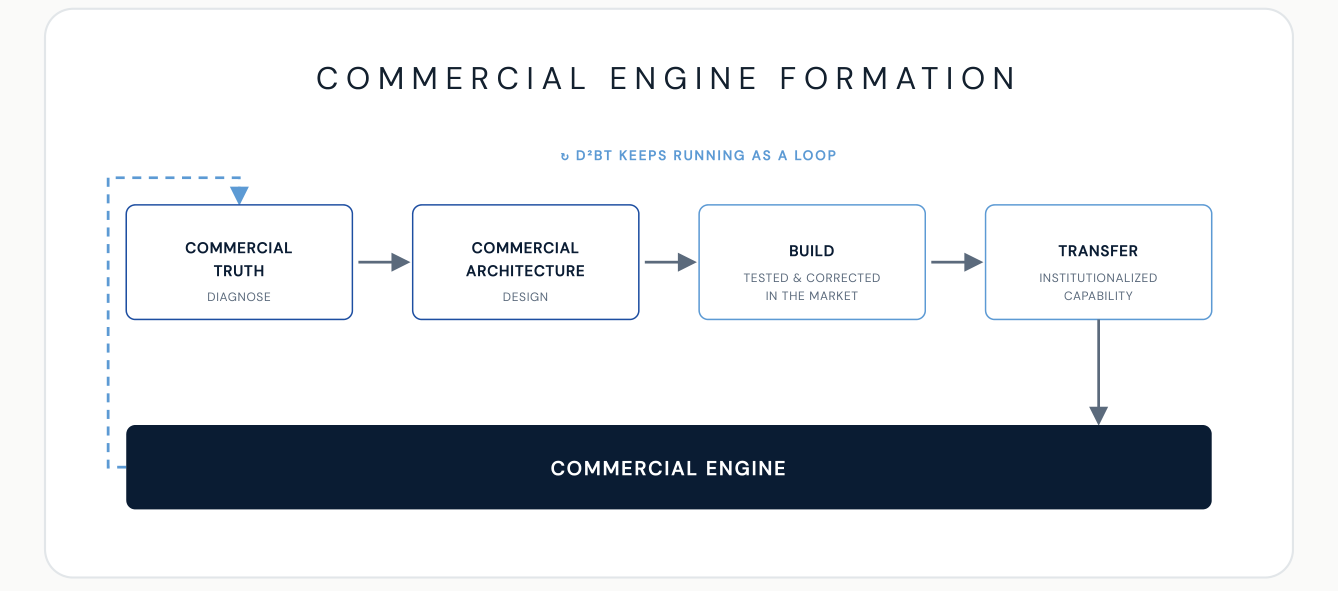
An engine is not a funnel and it is not a plan. A plan runs the same play until it stops working, and usually a while after that, because a plan has no way to hear that it has stopped. An engine is a loop that learns, and the loop is D²BT itself, running not once but continuously. This is where the throughline closes. Diagnose establishes what is currently true about the market. Design converts that truth into a commercial hypothesis, a set of explicit choices about how the company will win. Build exposes the hypothesis to the market and lets the market confirm it or correct it. Transfer turns what was learned into capability the organization holds rather than a lesson a few people carry. And then the market answers again, and the answer starts the loop over from a more accurate truth than the last one began with, so that the truth sharpens, the architecture tightens, the fit improves, and the capability compounds, turn after turn. Each handoff from one discipline to the next was the loop being drawn. The bundle that sent us back to redesign the price, the segment that needed its own fit, the correction that had to be transferred before it could stick, all of it was the same engine turning. That is why an engine understands more this quarter than it did last, and more next quarter than it does now. It improves on purpose, as a property of how it is built, whether or not the people who first built it are still in the room.
This is worth saying plainly, because the engine is constantly confused with three things it is not, and each confusion sends a company somewhere expensive.
It is not sales. Sales is a function inside the engine, the act of winning a customer. A company can have genuinely excellent salespeople and no engine at all, because the knowledge of why those people win lives inside them and leaves when they log off at night. Great selling is worth a great deal and it is still not a system. Sales is what a company does. The engine is what makes the doing repeatable by someone who was not there when it was first figured out.
It is not go-to-market. A go-to-market is a plan for how a company reaches its buyer, a motion chosen and put into the field. It is an input to the engine, not the engine itself. A motion can be elegant and wrong, and left alone it will stay wrong, defended quarter after quarter by the people who designed it. The engine is not the motion. It is the system that puts the motion in front of the market, reads the verdict honestly, and changes the motion when the market says change. A plan believes. An engine finds out.
It is not revenue operations. Revenue operations is the instrumentation, the tooling and the reporting and the measurement that keep the machine visible and running cleanly, and no serious company does without it. But instrumentation measures a motion; it cannot tell a company whether the motion is built on a buyer that actually exists. Wire a beautiful dashboard onto a misidentified buyer and the result is a mistake a company can watch in high resolution, in real time, while it fails. The plumbing is necessary, and it is not the thing it serves.
What the engine actually is, underneath all three, is organizational capability. It is the system that connects market truth, explicit commercial decisions, execution in the market, the learning that execution returns, and the institutional ability to do all of it again without the people who did it first. That is a different kind of asset than a good quarter or a strong team. A good quarter is an event. A strong team is a group of people. Capability is a property of the organization, and it is the one thing on that list a company still owns the morning after its best people resign.
Which is why building the engine is the right way, and it is worth being direct about why, because a company under pressure will almost always reach for one of three faster answers instead, and each one, on its own, leaves the same problem in place.
The first is to hire the problem away. Bring in a proven commercial leader to fix it. The problem is not hiring a leader. It is hiring a leader to become the engine rather than to build one. A leader brought in merely to carry the number recreates the dependency in a more expensive head, and when they leave, and eventually they leave, the company is exactly where it started, poorer and a year older. A leader brought in to diagnose the truth, design the architecture, validate it in the market, and transfer what was learned is doing something else entirely: building the capability and then handing it over. An experienced operator can accelerate that build enormously. But the work is complete only when the company owns what the operator helped it discover and build. Hiring can staff an engine. It cannot substitute for one.
The second is to buy the problem away. Add the platform, the data, the tooling, and let the stack impose the discipline the company lacks. But tools multiply whatever is already there. Point them at a validated motion and they scale it; point them at an assumption no one tested and they scale that instead, faster, at a larger cost, with a bigger number to miss at the end. A stack accelerates a truth. It cannot manufacture one.
The third is to keep riding the instinct that got the company here. The founders sold it into existence, so let them keep carrying it. That works, longer than it should, right up until it does not, because instinct does not transfer and the company quietly stays the exact size of the people holding it.
Each of these can play a real part inside an engine. None of them builds one alone, because each leaves the company’s ability to win sitting inside a person or a tool instead of inside the organization. Building the engine is the durable alternative, because it is the one effort that turns individual judgment into capability the company owns.
Sales, go-to-market, and revenue operations are functions a company operates. A Commercial Engine is a capability the company owns. A process depends on the people running it. An engine outlives them.
And that raises the one question a company has to answer before it spends another dollar trying to grow. Revenue is not the proof; the proof is whether the engine holds when the market runs its tests: the departure, the downturn, the buyer who changes their mind. Knowing that before those tests arrive, rather than after, is its own discipline. It is called readiness.
Build the Engine, Do Not Be It
I spent a career building these for other people, and I have to tell you where the idea finally came home, because for a long time I could not see it, and when I did it reorganized everything I thought I knew about the work. My whole career was the removal of a single disease. A founder, a founding team, the few who got something to work carry the commercial story around in their heads, and they hand me the download so I can build the system that runs without them. I was good at it. And one day I saw what I had actually been doing. I had spent years curing companies of depending on a few people and, without ever noticing, made a long line of them depend on me. The pipeline ran through me. The read on a market, the instinct for where a deal was stuck, all of it sat in one head, and the head was mine. I had been the cure, and I had quietly become the disease. In every story I could tell about this work, the last person standing between a company and its own engine was the person they hired to remove exactly that.
The discipline I preached and skipped was my own Transfer. I had handed over pieces of the method for years, inside companies and teams, and I had never once assembled the whole of it somewhere it could leave me completely. There was always a document at the turning point, the repositioning written down, the unified team written down, because the artifact is where an engine starts, the moment knowledge becomes more than a few heads can hold. But I had never written down the thinking behind all of it in one place. That is what this playbook turned out to be. Writing it was not documenting my process. It was completing the transfer.
Which leaves you where every company eventually stands, in front of the same quiet decision. Most will read this, nod, and reach for the easy lever anyway, because the pressure is real and the familiar doors are right there. A few will not. A few will set it down, get honest about where the business actually stands, and start building at the top of the list. If that is you, you are the reason it exists.
Either way the work is the same, and it starts where it always has. Not with more noise. Not with a rescue. Not with a baton handed to one more pair of hands. It starts with the quiet, deliberate decision to take the best thinking out of a few people’s heads and build the engine the company owns.
Build the engine. Do not be it.
You cannot hire your way out of a commercial engine you have not built.
Continue exploring.
Explore GAIN researchCommercial by Design © 2026 Gain Advisory LLC. All rights reserved.